


Marina di Camerota, Infreschi and Masseta Coast
Marina di Camerota is a waking dream, a succession of beaches, coves, cliffs and incredibly clear seabeds set between two small promontories topped by watchtowers. It offers an enchanting scene between the crystal-blue sea and lush green vegetation.
Lovers of rocky coastline, with its characteristic inlets and small beaches along Marina di Camerota’s shore, can quickly reach the Natural Arch beach near Capo Palinuro or head south along the Camerota coast toward Punta degli Infreschi, one of the most unspoiled stretches of Italy, where nothing has been built.
The spiaggia della Cala Bianca in Marina di Camerota is considered one of the most beautiful beaches in Italy, with crystal-clear water and seabeds that are a paradise for divers. By sea is certainly the easiest way to reach this cove, but boat stops are prohibited and the coast guard often passes. By land the experience is more intense, as the trail must be walked, so comfortable shoes and clothing more suited to trekking than swimming are recommended before changing on the beach.
The Pozzallo Beach has a small restaurant hidden in the greenery, offering comfort and a tasty lunch with a typical Cilento menu. Sun loungers can also be rented. From the point reachable by car, a walking trail leads to the beach in about 15-30 minutes, so comfortable shoes are recommended. The beach can also be reached by sea and is one of the landing points for excursion boats. The sea is crystal clear, although boat traffic may bother those seeking quiet. Pozzallo cave can also be reached by swimming.
Learn more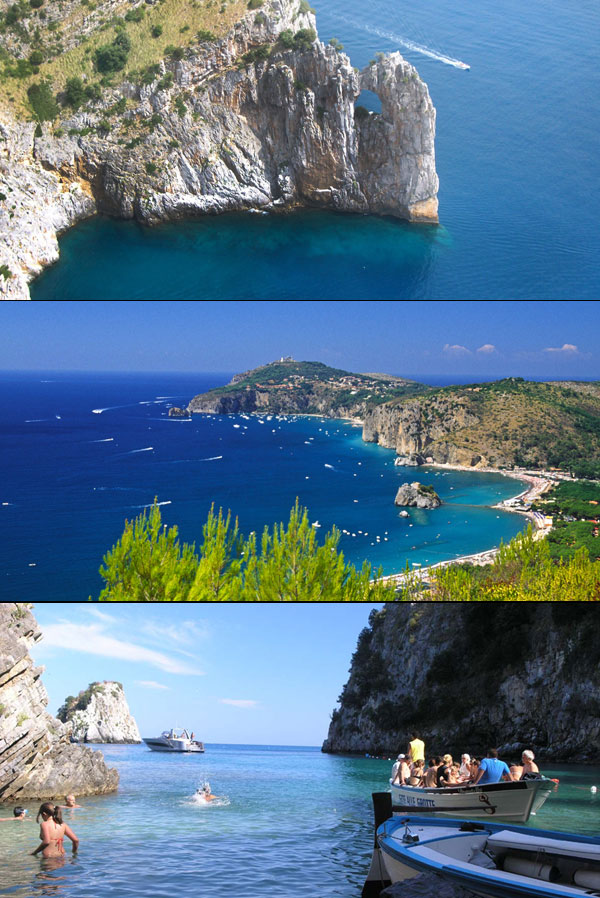
Capo Palinuro
Palinuro is an internationally known seaside resort, a limestone spur stretching into the southern Tyrrhenian Sea between olive-covered hills and a clean blue sea. It lies in the heart of Cilento and Vallo di Diano National Park, a UNESCO Biosphere Reserve. Its many beautiful beaches include sandy stretches, rocky coves, beaches in town and others reachable only by boat.
The crystal-clear Baia del Buondormire has one of the most romantic beaches on the coast. Another natural masterpiece is the Natural Arch, with its long beach and the nearby mouth of the Mingardo river. Diving into the seabeds of Capo Palinuro is one of the most exciting experiences in Cilento: the unspoiled sea holds an extraordinary wealth of flora and fauna.
Repeatedly awarded the Blue Flag for its bathing waters, Palinuro has also received the Green Flag for beaches considered among Italy’s best for families with children. The coastline is equally fascinating, unfolding into underwater caves, inlets and headlands waiting to be discovered.
The sea caves of Capo Palinuro
With 35 caves and submerged caverns, Capo Palinuro is one of the Mediterranean’s main sea-caving destinations. The most important caves, visited by boat and popular with tourists, are:
• Blue Cave: The best known and most visited cave in Capo Palinuro. Thanks to an underwater tunnel that lets sunlight enter, it creates the characteristic color from which it takes its name.
• Blood Cave: The cave has iron-rich walls that turn an intense red when they come into contact with seawater.
• Monks’ Cave: Like the other caves, it is rich in stalactites and stalagmites, some of which look like small monks in prayer.
• Silver Cave: It is the smallest of the caves usually visited on boat tours. Its walls, covered with limestone deposits, create a beautiful light effect that turns the sea silver.
• Sulfur Cave: It can only be visited from the outside, but is no less distinctive thanks to a sulfur spring with a strong smell.
Learn more

Charterhouse of Padula
The Charterhouse of San Lorenzo is the largest charterhouse in Italy and the second largest in Europe, located in Padula in the Vallo di Diano, province of Salerno. In 1998 it was declared a UNESCO World Heritage Site. The monastery has the largest cloister in the world, about 12,000 square meters, surrounded by 84 columns. A large white marble spiral staircase leads to the convent library. The main part of the Charterhouse is Baroque and covers 51,500 m² with more than 320 rooms.
Learn more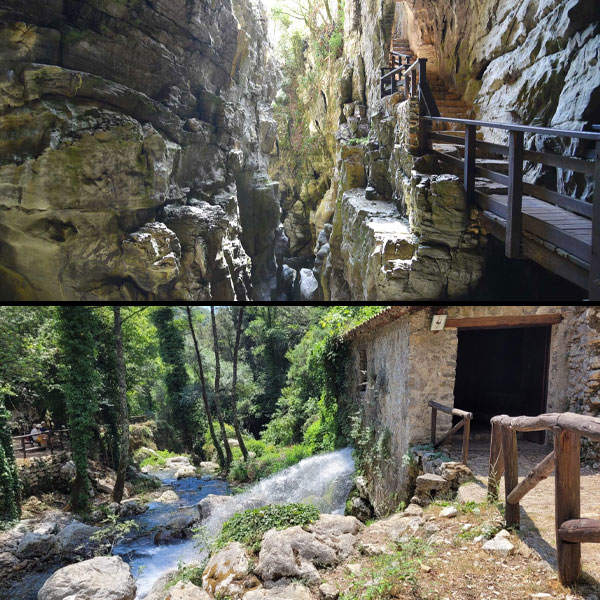
WWF Oasis of Morigerati
Trekking route in a canyon covered by lush vegetation to be visited along a path that winds from the historic center along a stream with springs, waterfalls, an ancient mill and finally to the cave where you can witness the resurgence of the karst river Bussento.
The excursion within our Oasis involves a walk of approximately 3 km. Along an ancient mule track (800 m long, 130 m above sea level, with various gradients, the steepest at one point being 14%) you reach:
- the Grotta della Risorgenza of the Bussento River, an important karst phenomenon;
- the moss and lichen station, the largest in southern Italy;
and following “lu jumi ri coppa”, a small tributary of the Bussento River, you reach the ancient water mill with a horizontal wheel.
From here you take the mule track back up to the village.
Capelli di Venere Waterfalls
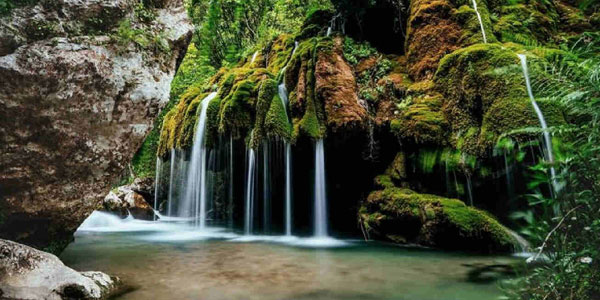
the reference point is the small village of Casaletto Spartano. The waterfalls are immersed in the nature of an unspoiled oasis. The beauty of the place is in the encounter between the water games and the green nature that welcomes it. Here the Rio Bussetino meets the drop that generates the waterfalls and is caressed by the Capelvenere fern, which elegantly creates a fascinating play of colors. After taking some selfies, several paths start from here. Trekking enthusiasts can follow less beaten paths. Ideal for families, there is also a suggestive path through wooden bridges.
In general, the route is about 3 km round trip, with an elevation gain of 200 m and a duration of about 1 hour. The difficulty is very low, as it is a tourist trail suitable for everyone, classified as T and with a maximum altitude of 483 meters.
The picnic area is not located at the waterfalls but is the equipped destination with tables, barbecue areas, bathrooms and everything needed for a refreshment immersed in nature. Just be sure to get there early or it might all be occupied!
Scario
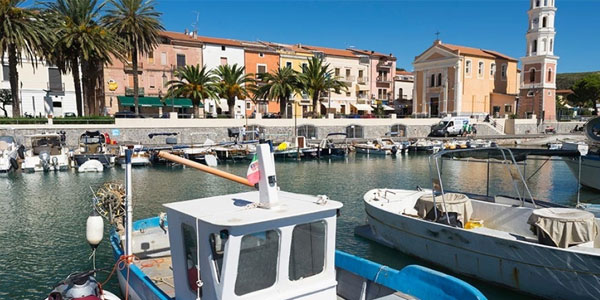
This seaside village deserves a special mention as a significant tourist destination for the quality of its waters and its location, being the seaside village closest to the unspoiled Masseta coast.
Several excursions depart from the Scario harbor to one of the most beautiful locations in the park: "Punta degli Infreschi". The coast from Scario to the point is dotted with karst caves, coves reachable only by sea and watchtowers. There is no land route to reach these places, so you need to equip yourself with a boat or other watercraft.
The Rione Sant'Anna is one of the most characteristic corners. A string of ancient houses overlooking the sea cluster around the small chapel dedicated to the saint, protector of pregnant
Learn more
Elea Velia Archaeological Park
The ancient Greek city of Helea is of great historical importance as the home of Parmenidean philosophy. In March 1965 the "Porta Rosa" was brought to light, the only known example of an arch in Greek architecture. Also noteworthy is the Angevin Tower, a symbol of the surrounding area, standing on the blocks of the Temple of Athena and on the acropolis of the ancient city.
Learn more
Paestum Archaeological Park, the temples and the museum
An ancient city of Magna Graecia founded as Poseidonia in the 7th century BC, it still shows the great richness of its past. Its three perfectly preserved temples, set within the ruins of the city, are imposing. The archaeological museum is among the richest of its kind, and the fresco from the "Tomb of the Diver" is famous worldwide.
Learn more
Castellabate
The old town has preserved the layout of a typical medieval citadel, later enriched by noble residences from the 17th century, especially Palazzo Perrotta and Palazzo Iaquinto, worth visiting for the many works of art they house. The highlight of the hilltop village is the Church of Santa Maria de Gula, built in the 12th century and elevated to Pontifical Basilica in 1988.
Santa Maria di Castellabate is the largest hamlet, a highly appreciated tourist destination and home to a marine protected area. The spectacular Punta Tresino, gateway to Cilento National Park, is well worth a visit.
The village became famous throughout Italy thanks to Luca Miniero’s films "Benvenuti al Sud" (2009) and "Benvenuti al Nord" (2012).
Learn more